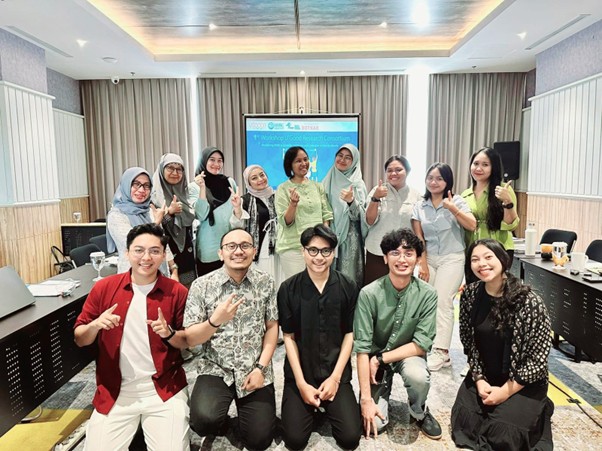
Faculty and doctoral students from ITB Environmental Engineering participated in the first internal U’GOOD consortium workshop on 8–9 January 2026 at the Pasopati Room, Hotel Porta, Yogyakarta.
The workshop formed part of the collaborative project “Redefining relational wellbeing to bolster resilience and collective action in climate change in Indonesian youth”, funded by Fondation Botnar, Switzerland, and managed by South Africa’s National Research Foundation and Human Sciences Research Council. The consortium brings together Universitas Gadjah Mada (UGM), Universitas Udayana (UNUD), and ITB with youth community partners Kolaborasi Bumi and SPEAK Indonesia. The workshop was hosted by UGM’s Center for Health Behavior and Promotion, Faculty of Medicine, Public Health and Nursing.
The ITB Delegation’s Contribution
Dr. Anindrya Nastiti and doctoral student Rismalia Dana Putri represented ITB Environmental Engineering. They led a presentation on Relational Wellbeing (RWB), highlighting intersections emerging from their scoping review: youth, relational wellbeing, adaptation infrastructure, and environmental risk.
The team explained that conventional environmental risk assessment and adaptation infrastructure planning often focus on technical and material aspects. An RWB approach instead examines how adaptation infrastructure interacts with young people’s social lives. Infrastructure should provide more than physical protection; it also needs to support the relationships that shape youth wellbeing.
Aligning Methods and Institutional Work
The workshop also developed the project’s administrative and methodological foundations. UGM led discussion of ethics review, funding, and the division of responsibilities. UNUD led sessions on research methods, data collection timelines, and qualitative instruments.
Planned participatory approaches with youth communities included focus group discussions, participatory mapping, and photovoice. ITB’s involvement demonstrates its contribution to environmental research that connects adaptation, human wellbeing, and young people’s climate resilience.